
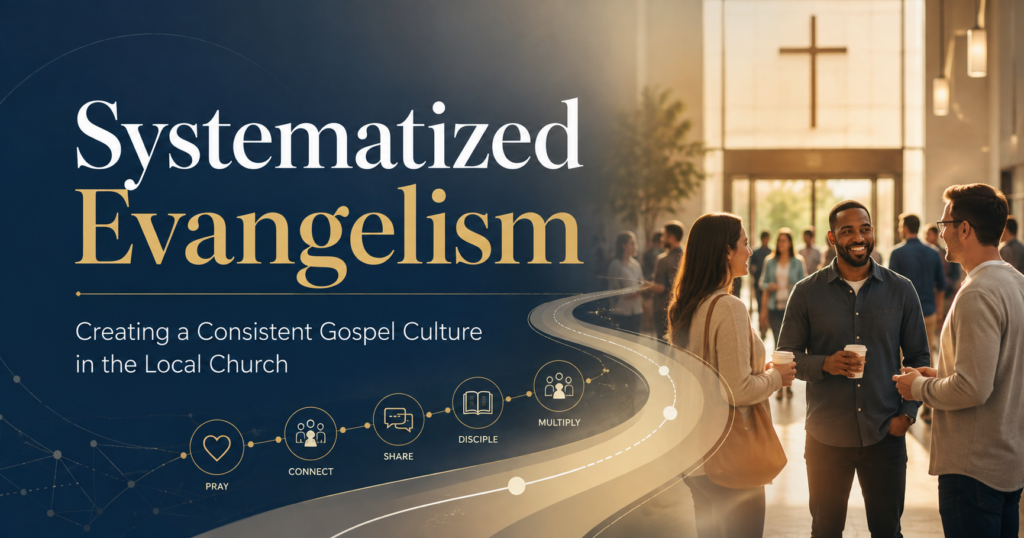
Systematized Evangelism: Creating a Consistent Gospel Culture in the Local Church
By Steve Foster
One of the most insightful observations I’ve ever read came from Scott Newton Smith regarding church systems and evangelism. His thoughts remind us that churches reaching people consistently with the gospel rarely do so accidentally.
They do it intentionally.
Systematized evangelism creates a consistent focus on the Great Commission.
Scott made an interesting comparison:
“How is it that Chick-fil-A can set up a franchise location, have it run by teenagers getting paid minimum wage, and still become one of the most successful restaurants in town with a near-zero failure rate? The answer is systems.”
That same principle applies to evangelistic churches.
As we study highly evangelistic churches of all sizes, one common denominator consistently emerges: they have developed repeatable systems that intentionally connect people with the gospel. These churches understand that while salvation only happens through the power of the Holy Spirit, healthy systems help maximize opportunities for gospel encounters.
A church does not drift into evangelistic effectiveness. It requires intentional plans, processes, and consistent emphasis.
What Does Systematized Evangelism Look Like?
1. Preaching with Lost People in Mind
Evangelistic churches preach every Sunday as though lost people are present—because they usually are.
These churches strive to create guest-friendly environments where the gospel is regularly and clearly communicated regardless of the sermon topic. Pastors consistently offer opportunities for response and salvation. This keeps the entire congregation focused on the priority of reaching people far from God.
2. Equipping Small Groups for Outreach
Healthy evangelistic churches ensure that every small group, Sunday School class, or discipleship gathering maintains a gospel focus.
Many churches go a step further by encouraging groups to adopt outreach projects, ministry opportunities, or evangelistic events throughout the year. This naturally creates environments where personal evangelism becomes part of church culture rather than a special event.
3. Mobilizing Prayer for Lost People
Every gospel movement begins with prayer.
Churches seeing spiritual harvest often have intentional systems that encourage members to pray consistently for lost people by name. Prayer not only prepares hearts for the gospel, but it also raises evangelistic awareness within the church itself.
Praying people become burdened people. Burdened people become witnessing people.
4. Creating a Culture of Invitation
Many church members may never preach a sermon or lead a Bible study, but most believers can invite someone to church or a ministry event.
Evangelistic churches understand this reality and make inviting easy, frequent, and natural. They provide invitation tools, encourage relational outreach, and celebrate members who bring guests.
Simple invitations often open doors for life-changing gospel conversations.
5. Infusing the Gospel into Community Ministry
Many churches serve their communities through compassion ministries, food distribution, tutoring programs, recovery ministries, sports outreach, and other acts of kindness.
Evangelistic churches intentionally connect those ministries to gospel conversations.
Meeting physical and emotional needs is important, but the greatest need every person has is a relationship with Jesus Christ. Churches committed to evangelism ensure the gospel remains central in every ministry expression.
6. Providing Regular Evangelism Training
Churches that consistently reach people prioritize ongoing evangelism training.
They do not assume members automatically know how to share their faith confidently. Instead, they provide simple, accessible training opportunities throughout the year and regularly communicate the importance of personal evangelism from the pulpit.
Training builds confidence. Confidence increases obedience. Obedience leads to gospel conversations.
Evangelism Must Be More Than an Event
For many churches, evangelism has become occasional rather than operational. It is emphasized during revivals, mission weeks, or special campaigns, but not woven into the ongoing rhythm of church life.
Systematized evangelism changes that.
It creates a culture where prayer, gospel conversations, invitations, outreach, and evangelism training become normal parts of ministry life—not occasional emphases.
No system can replace the power of the Holy Spirit. But healthy systems can consistently position churches and believers for greater gospel impact.
Questions for Church Leaders
- Is evangelism currently a system in your church or merely an occasional emphasis?
- Are your ministries intentionally creating gospel opportunities?
- Are your members regularly praying for and engaging lost people?
- Does your church calendar reflect the Great Commission as a priority?
- What simple systems could your church begin implementing this year?
Action Steps
- Evaluate your current church systems and identify where evangelism is missing.
- Encourage every ministry area to include intentional gospel opportunities.
- Develop a church-wide prayer strategy for lost people by name.
- Provide simple invitation tools and encourage members to use them weekly.
- Schedule regular evangelism training opportunities for your congregation.
- Celebrate every salvation story publicly to reinforce evangelistic culture.
- Begin building repeatable processes that keep the Great Commission in front of your church year-round.
Churches rarely become evangelistic by accident. Intentional systems help create intentional gospel engagement.
The question is not whether your church has systems. Every church does.
The real question is: are your systems helping advance the gospel?
Published August 3, 2026